
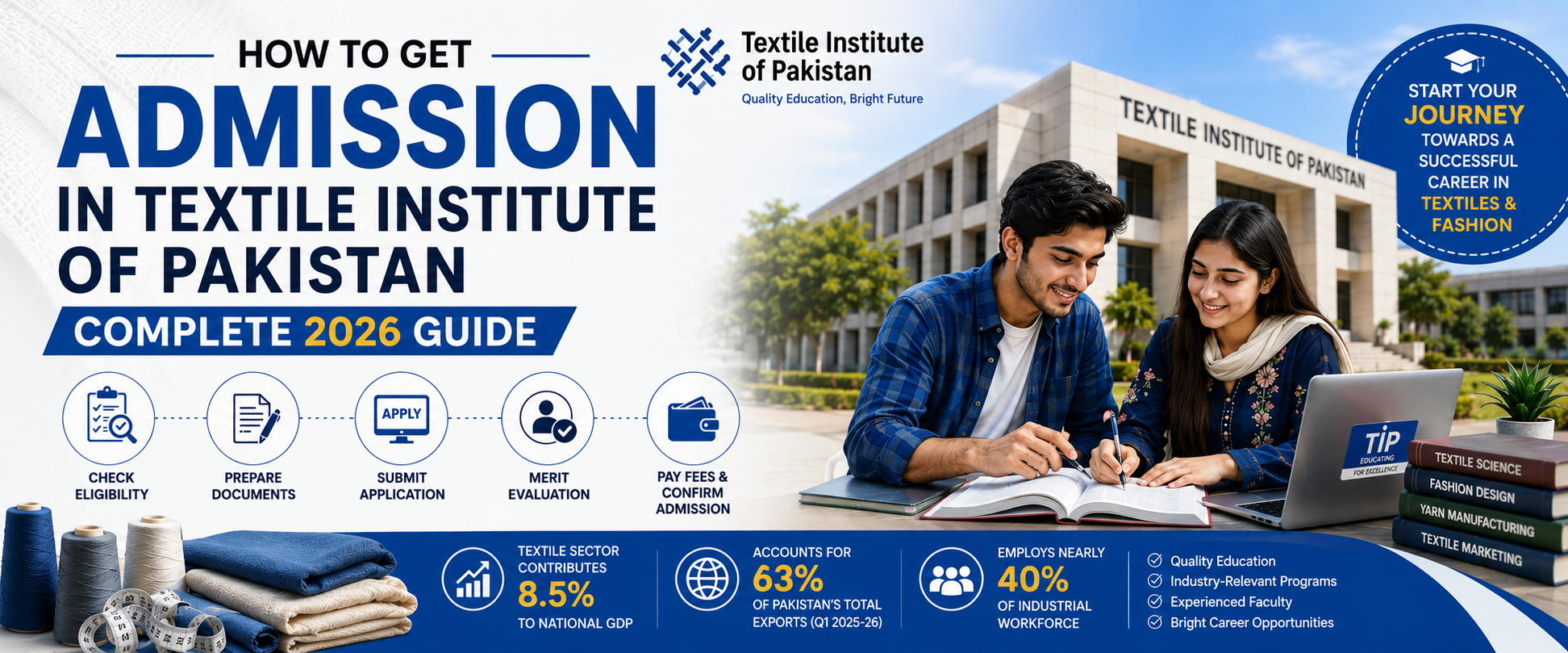
If you have been searching for a clear answer on how to get admission in Textile Institute of Pakistan, you are in the right place. TIP is one of the most respected names in textile and fashion education in the country, and every year hundreds of students want to join it. The good news is that the admission process is simple once you understand each step. This guide breaks everything down in plain language so you know exactly what to do, what to prepare, and when to apply.
Let us walk through the whole journey together, from checking if you are eligible to paying your fees and applying for a scholarship.
Why Students Choose TIP?
Before we get into the steps, it helps to understand why so many students pick TIP. The textile sector is the backbone of Pakistan’s economy. It is the country’s largest export earner, and the textile group accounted for about 63 percent of Pakistan’s total exports in the first quarter of the 2025 to 2026 financial year, according to the Pakistan Textile Council. The sector also contributes around 8.5 percent of the national GDP and employs close to 40 percent of the industrial workforce, as reported by Arab News and other outlets.
What does this mean for you? It means there is real demand for skilled people who understand textiles, design, and the business side of fashion. TIP trains you for exactly these roles. Many of its graduates have gone on to lead marketing teams, run their own companies, and take senior positions at well-known brands like Sapphire, Outfitters, and SM Denim Mills. So a degree here is not just a certificate. It is a strong start to a career in an industry that keeps the country running.
Step 1: Check If You Are Eligible
The first thing to do is make sure you meet the basic academic requirements. TIP keeps these clear and fair, and the bar depends on which program you want to join.
For the BS Sustainable Textiles program, you need a minimum of 45 percent marks in your Intermediate, and you can come from any discipline. If you studied GCE A-Levels instead, you must have completed at least three relevant subjects such as Mathematics, Chemistry, and Physics, with a minimum grade of D or its equivalent.
For the BBA programs and other degrees, the requirement is a little higher. You need at least 50 percent marks in your Intermediate from any discipline. A-Level students follow the same subject rule as above, with three relevant subjects at a minimum grade D or equivalent.
There are a couple of important notes here. If you studied A-Levels or any foreign qualification, you must submit an equivalency certificate from the IBCC. If you have some other qualification that does not fit neatly into these categories, the Admission Committee will review it and decide.
One more useful point. If your Intermediate Part Two results are not out yet, you can still apply using your Part One results. This kind of application is treated as provisional. Just remember that once your final results come out, you must meet the minimum marks for your chosen program. If you fall short, the admission gets cancelled automatically. So apply early, but stay realistic about your final grades.
Step 2: Understand How Merit Is Calculated
A lot of students worry only about their Intermediate marks, but TIP looks at more than that. Your final selection is based on a merit formula that gives weight to three things.
Your Intermediate or A-Level marks count for 20 percent. Your entry test score counts for 50 percent, which is the biggest part. Your interview performance counts for the remaining 30 percent.
This is good news for many applicants. Even if your school marks are average, a strong test score and a confident interview can lift you well up the merit list. So do not feel discouraged by past grades. Focus your energy on preparing for the test and the interview, because together they make up 80 percent of your result.
Step 3: Prepare for the Admission Test
The entry test is the heart of the whole process, so it deserves your full attention. Here is what you can expect.
The test has three components and is conducted in English. It checks how well you remember facts, how well you can apply what you know, and how good you are at solving problems. The questions are drawn from the current syllabus set by the Board of Intermediate Education in Pakistan, so you are not being tested on anything strange or unfamiliar. If you studied properly for your Intermediate, you already have a strong base.
Since English is the language of instruction at TIP, your command of English matters. You need to be comfortable reading, writing, and speaking it. This is worth practicing if English is not your strongest area, because it shows up across the test and again in the interview.
There is one special note for design students. If you are applying for the Textile Design Technology program, you also have to take a separate drawing test to show your creative and visual skills. So if design is your goal, keep your sketching practice going alright before test day.
To prepare well, go through your Intermediate notes in the main subjects, practice English comprehension and writing, and try to solve sample questions under timed conditions. TIP provides a sample test paper and test guidelines on its website, and going through these will give you a clear feel for the format before you sit the real thing.
Step 4: Pass the Interview
If you do well in the test, you will be invited for an interview. This is conducted only in English, so be ready to talk about yourself, your interests, and why you want to study at TIP, all in English.
The interview is your chance to show your personality and your passion for the field. Speak clearly, stay calm, and be honest. The panel wants to see that you are genuinely interested and that you will fit well into the TIP community. Since the interview carries 30 percent of your merit, treat it as seriously as the test.
Step 5: Bring the Right Documents
When it is time to register, you need to bring your original documents along with photocopies. The Registrar’s office will check the originals and then attest your copies. Bringing everything in order saves you from delays and repeat trips, so prepare a folder with your result cards, equivalency certificate if needed, and any other paperwork ahead of time.
Step 6: Know the Important Dates
Timing matters a great deal in admissions. Missing a deadline can cost you a whole intake, so mark these dates clearly. For the current cycle, TIP listed the following key dates on its admission page:
The application deadline is 29th June 2026. The test date is 4th July 2026. The result is announced on 9th July 2026. Orientation day and the start of the session were set for 19th January 2026 for the relevant intake.
Dates can shift slightly from one cycle to the next, so always confirm the latest schedule on the official TIP website before you plan around them.
Step 7: Understand the Fee Structure
Knowing the costs upfront helps you plan with no surprises. Here is a simple breakdown based on TIP’s published fee structure. Note that TIP has marked this structure as being for the 2023 to 2024 year and under review, so treat these as a guide and confirm the current numbers before paying.
There are a few one-time charges to begin with. The admission pack costs Rs. 2,000 and is non-refundable. The admission fee is Rs. 25,000 and is also non-refundable. There is a security deposit of Rs. 20,000, which is refundable. This deposit covers things like microscopes, lab equipment, learning aids, and the library, and you get it back at the end of your degree, minus any damage costs.
Then there is the semester fee. The tuition fee is Rs. 10,000 per credit hour, and each semester usually carries 15 to 18 credit hours. On top of that, there is a charge of Rs. 6,500 that covers TISF, your ID card, and accidental insurance.
If you need transport, the fee from the city is around Rs. 85,000 per student, while transport from Steel Town or Gulshan-e-Hadeed is around Rs. 23,000 per student. These transport charges can change with fuel prices.
For students who want to live on campus, the hostel fee is Rs. 80,000 for a separate room and Rs. 65,000 for a sharing room.
A few things are worth remembering. Payments are made through a fee voucher at any Bank Al Habib branch across Pakistan. A late payment penalty of Rs. 3,000 applies if you miss the deadline. There is also a 5 percent advance tax under the Income Tax Ordinance that is added to fees, though this can be adjusted against a parent’s or guardian’s tax liability.
TIP also has a fair refund policy. You get a full refund of all fees, except the admission and security deposit, if you withdraw up to the seventh day after classes begin. You get a half refund from the 8th to the 15th day. After the 16th day, no refund is given.
Step 8: Apply for Scholarships and Financial Aid
Here is the part that many students miss. TIP does not want money to stand between a talented student and a good education. As an HEC-recognized institution, it offers a wide range of scholarships, interest-free loans, and Shariah-compliant support. If your finances are tight, there is very likely an option for you.
Let us look at some of the main ones.
The KJA 2003 Memorial Scholarship is alumni sponsored and need-cum-merit based. It covers up to 60 percent of the tuition fee, and you need at least 65 percent in your Intermediate or equivalent.
The Feroza and Khawaja Qamar-ul-Hasan Scholarship is merit based and covers your full annual tuition. For this one you need a strong 80 percent in your Intermediate or equivalent.
The Meezan Bank Scholarship is need-cum-merit and corporate funded. It covers up to 50 percent of tuition, with a requirement of at least 70 percent in your Intermediate.
The Industrial Scholarships are need-cum-merit and industry sponsored. These can cover up to 100 percent of tuition, with a requirement of at least 65 percent in your Intermediate.
Beyond these, TIP offers interest-free educational financing through the Ihsan Trust, which can cover up to 70 percent of tuition with no hidden charges and flexible repayment. There is also Zakat-based support from the Tabba Foundation and the Arif Habib Foundation, both of which can cover up to 100 percent of tuition for deserving students who qualify under Shariah-compliant rules.
If paying in one go is hard, TIP also offers flexible tuition payment plans that let you pay in manageable installments. And there are family benefit programs too, such as support for the children of TIP staff and the children of employees at partner textile companies.
One important rule to keep in mind. If you are already receiving any scholarship or financial assistance, you cannot apply for an additional one. So pick the option that suits you best.
New students can apply for scholarships at the time of admission, while current students apply during announced cycles. For need-based aid, you may need to provide documents like income proof, salary slips, bank statements, or utility bills. You can reach the Financial Aid office for personalized guidance, and TIP provides a document checklist on its website to help you prepare.
Step 9: Submit Your Application Online
Once you have checked your eligibility and gathered your documents, the actual application is done online through the TIP admission portal. From there you fill in your details, choose your program, and follow the prompts. Keep your documents handy so you can move through the form smoothly.
A Quick Recap of the Journey
To bring it all together, here is the full path in simple terms. First, confirm you meet the marks requirement for your program. Second, understand that the test and interview carry most of your merit. Third, prepare seriously for the English-based entry test, plus the drawing test if you are a design applicant. Fourth, do well in the English interview. Fifth, keep your original documents ready for verification. Sixth, watch the deadlines closely. Seventh, plan for the fees. Eighth, apply for a scholarship if you need help with costs. And finally, submit your application online before the deadline.
None of these steps are hard on their own. The students who get in are usually the ones who start early, prepare steadily, and stay organized. If you follow this guide and keep checking the official TIP pages for the latest dates and figures, you will be in a strong position to earn your place.
TIP has shaped the careers of many leaders in Pakistan’s textile and fashion world. With a clear plan and steady effort, your name could be next on that list. Take the first step today, and give yourself the chance to build a future in one of the country’s most important industries.


