Connecting Research, Industry, and Innovation for a Sustainable Textile Future
The Office of Research, Innovation & Commercialization (ORIC) at Textile Institute of Pakistan fosters cutting-edge research, sustainable textile technologies, industry partnerships, entrepreneurship, and commercialization of innovative solutions for the global textile sector.

Dr. Muhammad Kamran Khan
Textile Institute of Pakistan
At ORIC, we are committed to fostering a dynamic ecosystem where research, innovation, and industry collaboration drive sustainable development and technological advancement. As the textile sector evolves through sustainability, circular economy practices, digital transformation, and advanced materials, our focus is on connecting academia with industry to develop practical solutions, promote technology transfer, and commercialize research with real-world impact. I invite our faculty, students, researchers, industry partners, and international collaborators to join us in advancing innovation, entrepreneurship, and research excellence that strengthens Pakistan's textile sector and contributes to global sustainable development. Together, let us transform knowledge into innovation and innovation into lasting impact.
ORIC is driving impactful research in sustainable textile technologies, environmental compliance, and resource recovery. Our ongoing projects include nano-encapsulated natural dyes for polyester coloration, microplastic monitoring in textile processes, and the conversion of ETP sludge into high-performance fuel briquettes. These initiatives demonstrate our commitment to innovation, sustainability, and industry-focused solutions for the future of Pakistan's textile sector.
Where Our Research Focuses
Sustainable Textiles & Circular Economy
Reducing waste and closing material loops across the textile value chain.
Textile Chemistry & Green Processing
Eco-friendly dyeing, finishing, and chemical processing solutions.
Nanotechnology & Smart Textiles
Functional fabrics with antimicrobial, UV, and moisture-management properties.
Waste Valorization & Resource Recovery
Converting industrial byproducts into fuel, energy, and reusable materials.
Environmental Compliance & Microplastics Research
Monitoring and mitigating microplastic release from textile manufacturing.
Industry 4.0 & Digital Textile Manufacturing
AI-driven optimization of production, energy, and resource efficiency.
Featured Projects
Nano-Encapsulation of Natural Dyes for Sustainable Polyester Coloration
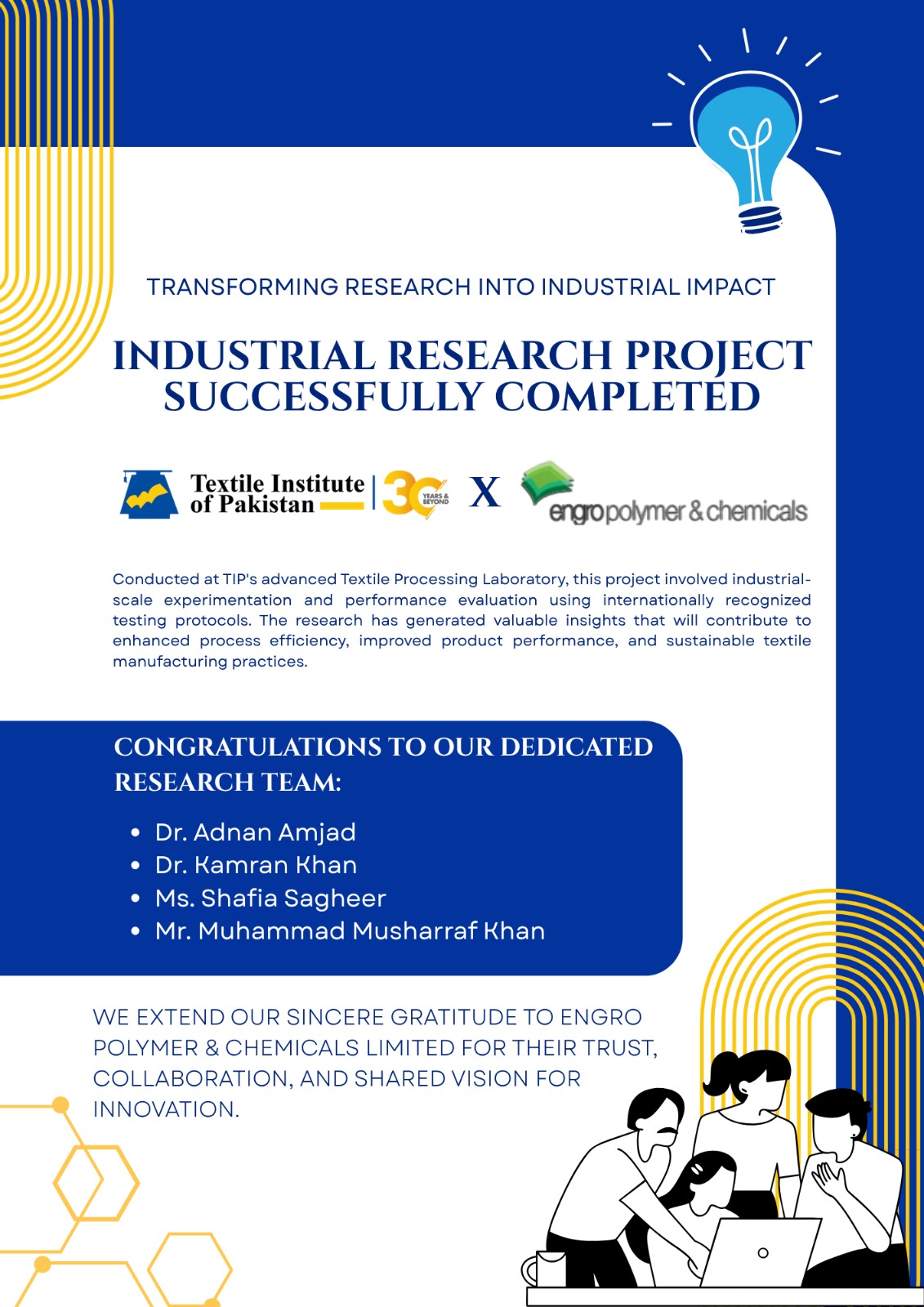
Development of nano-encapsulated natural dye systems to improve dye uptake, color fastness, and durability on polyester fabrics while reducing dependence on synthetic dyes and hazardous chemicals. The project promotes eco-friendly textile coloration and sustainable manufacturing practices.
Microplastic Pollution Assessment in Pakistan's Textile Industry
A comprehensive investigation into the generation, release, and environmental impact of microplastics from textile manufacturing and laundering processes. The project aims to develop monitoring protocols and mitigation strategies that support environmental compliance and sustainable textile production.
Utilization of ETP Sludge for High-Performance Fuel Briquettes
Transforming textile effluent treatment plant (ETP) sludge into value-added fuel briquettes through innovative waste-to-energy technologies. The project supports circular economy principles by reducing industrial waste and creating alternative energy resources for industrial applications.
Development of Antimicrobial and Functional Smart Textiles
Design and characterization of advanced textile materials with antimicrobial, moisture-management, UV-protective, and comfort-enhancing properties for healthcare, sportswear, and technical textile applications. The project integrates nanotechnology and functional finishing techniques to create next-generation textile products.
AI-Driven Resource Optimization for Sustainable Textile Manufacturing
Application of artificial intelligence and data analytics to optimize water consumption, energy utilization, chemical dosing, and production efficiency in textile processing. The project supports Industry 4.0 adoption while helping manufacturers achieve sustainability and cost-reduction goals.
Industry Partners