
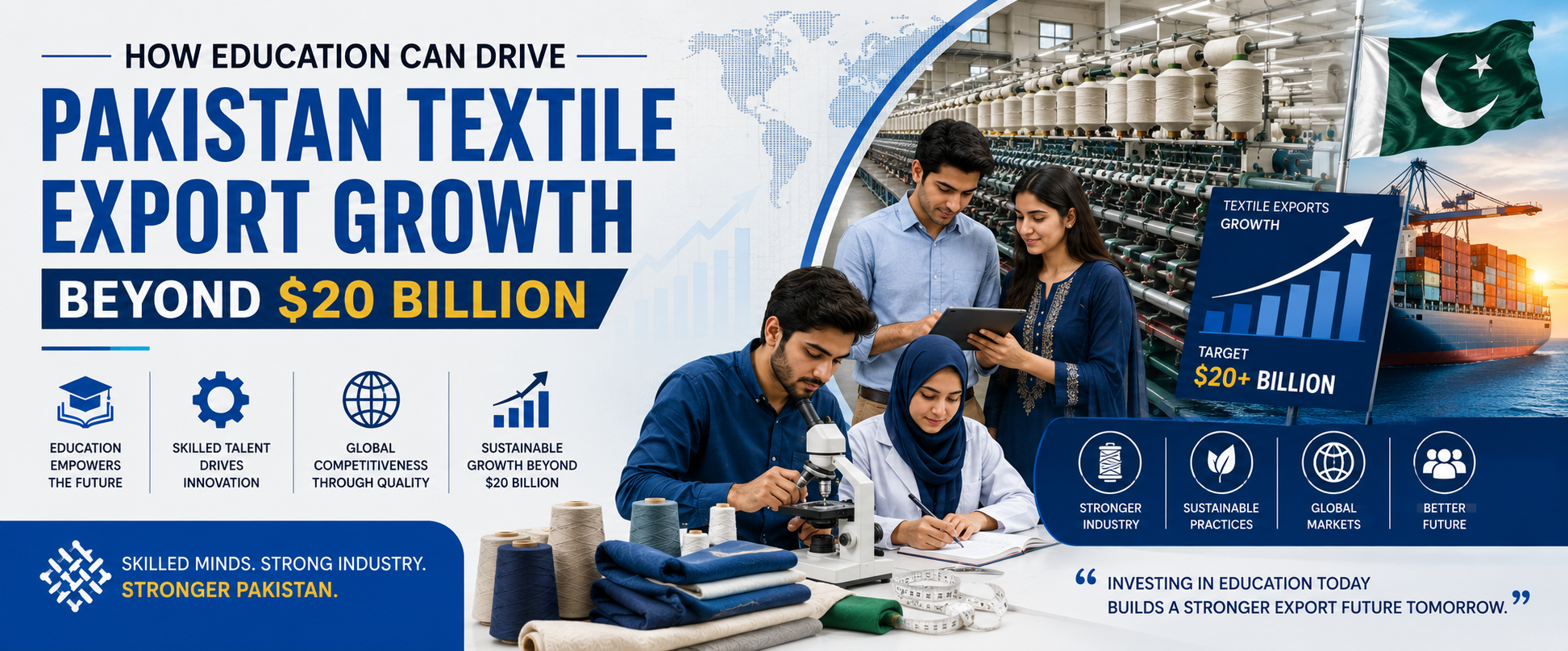
Pakistan’s textile industry has long been the backbone of the country’s economy. It is the largest manufacturing sector, one of the biggest employers, and the leading source of export earnings. From cotton yarn and fabrics to garments and home textiles, Pakistani products are supplied to markets across Europe, North America, Asia, and the Middle East.
Despite its strong position, Pakistan still has significant room for growth. The country has the resources, industrial base, and manufacturing experience needed to increase exports further. However, reaching the next level requires more than new factories or modern machines. It requires skilled people who understand textile production, technology, sustainability, quality management, product development, and global market demands.
This is where textile education becomes one of the most powerful tools for supporting Pakistan’s textile export growth. Universities and specialized institutions prepare future professionals who can introduce innovation, improve manufacturing processes, create value-added products, and strengthen the industry’s international competitiveness.
According to the Pakistan Bureau of Statistics, textiles and clothing account for around 60 percent of Pakistan’s total exports, making the sector the country’s largest export industry. This shows how closely Pakistan’s economic performance is connected with the success of the textile sector.
At the same time, the Pakistan Economic Survey 2024 to 2025 states that the textile sector remains the largest manufacturing industry in the country and continues to make a significant contribution to employment, industrial production, and exports.
These figures highlight one important reality. If Pakistan wants to increase exports beyond the current level, investment in people must grow alongside investment in technology.
This article explores how education can help Pakistan’s textile industry grow beyond the $20 billion export mark and why developing skilled professionals is essential for long-term success.
Understanding Pakistan's Textile Industry
The textile industry is much larger than garment manufacturing alone. It includes every stage of production, from raw cotton to finished apparel and home textile products.
Pakistan’s textile value chain includes spinning, weaving, knitting, dyeing, finishing, garment manufacturing, home textiles, technical textiles, quality testing, product development, merchandising, logistics, and exports.
Each stage depends on trained professionals who understand production processes and international quality standards.
As global competition becomes stronger, companies need graduates who can improve productivity, reduce waste, develop innovative products, and satisfy international buyers.
Why the $20 Billion Export Mark Matters
Crossing the $20 billion export mark is important because higher exports bring more foreign exchange, create employment opportunities, strengthen industries, and contribute to national economic growth.
Greater export earnings also encourage investment in modern manufacturing facilities, research, and product development.
However, achieving sustainable export growth requires more than increasing production volumes.
Manufacturers must improve quality, develop value-added products, follow international compliance standards, and respond quickly to changing customer preferences.
These improvements depend on educated professionals working throughout the textile supply chain.
Pakistan's Position in the Global Textile Market
Pakistan is recognized internationally for its cotton production and textile manufacturing capabilities.
The country exports a wide range of products including cotton yarn, fabrics, knitwear, garments, towels, denim, bed linen, and home textiles.
According to the International Trade Centre, Pakistan remains among the leading textile exporting countries, particularly in cotton-based products and home textiles.
Global buyers increasingly expect suppliers to provide innovative products, sustainable manufacturing, and consistent quality.
Meeting these expectations requires continuous investment in education, research, and workforce development.
Challenges Limiting Export Growth
Pakistan’s textile industry has achieved remarkable success, but several challenges continue to affect export performance.
Some of the major challenges include:
- Shortage of highly skilled professionals
- Limited investment in research
- Rising production costs
- Increasing international competition
- Environmental compliance requirements
- Technology adoption
- Product innovation
- Quality consistency
- Supply chain efficiency
- Changing global fashion trends
While modern machinery can improve production, skilled professionals are needed to operate equipment efficiently and solve technical problems.
Why Textile Education Matters
Education is one of the strongest foundations of industrial development.
Students studying textile sciences, textile engineering, apparel manufacturing, textile chemistry, textile design, merchandising, and quality management gain the knowledge required to improve every stage of textile production.
A well-educated workforce helps industries:
- Improve productivity
- Reduce manufacturing errors
- Increase product quality
- Develop innovative products
- Strengthen exports
- Improve customer satisfaction
- Meet international standards
- Reduce production waste
Education transforms scientific knowledge into practical industrial solutions.
The Link Between Education and Export Growth
Countries with strong manufacturing industries invest heavily in education and technical training.
Graduates entering the workforce introduce new ideas, improve production methods, and help companies remain competitive.
For Pakistan, this means universities play an important role in preparing professionals who understand modern textile manufacturing, quality assurance, sustainability, digital technologies, and international trade.
The stronger the education system becomes, the greater the industry’s ability to compete in global markets.
Skills That Modern Textile Companies Need
Today’s textile companies expect graduates to possess more than technical knowledge.
Modern professionals must combine science, technology, communication, and management skills.
Some of the most valuable skills include:
- Textile manufacturing knowledge
- Quality assurance
- Communication skills
- Problem-solving
- Digital literacy
- Product development
- Supply chain understanding
- Sustainability practices
- Research skills
- Teamwork
Graduates with these abilities contribute directly to stronger export performance.
Education Supports Product Innovation
International buyers constantly search for products that offer better quality, improved performance, and attractive designs.
Innovation helps manufacturers introduce products that meet changing customer expectations.
Textile education encourages students to experiment with new fibers, sustainable materials, dyeing methods, finishing techniques, and digital technologies.
These innovations allow Pakistani manufacturers to move beyond basic textile products and develop higher-value exports.
Importance of Research and Development
Research is essential for long-term industrial growth.
Universities and research centers help industries solve manufacturing challenges, improve product quality, reduce production costs, and introduce environmentally responsible technologies.
Research also supports the development of technical textiles, recycled materials, smart fabrics, and advanced textile applications.
Countries that invest in research generally achieve stronger industrial competitiveness.
Textile Education Creates Industry-Ready Graduates
Employers prefer graduates who understand industrial environments before beginning their careers.
Practical education helps students become familiar with production systems, quality control, laboratory testing, digital software, and manufacturing processes.
This reduces training time and allows graduates to contribute more quickly after joining companies.
Industry-ready graduates improve productivity while helping manufacturers maintain international quality standards.
Industry and Universities Must Work Together
Strong collaboration between educational institutions and textile companies benefits both students and employers.
Universities understand emerging technologies while industries understand current market needs.
Working together allows both sides to develop graduates with relevant skills.
Industry Need | Educational Response |
Better quality | Quality management education |
Product innovation | Research and development projects |
Digital manufacturing | Modern software training |
Sustainable production | Environmental education |
Skilled workforce | Industry-focused curriculum |
Global competitiveness | International business knowledge |
These partnerships strengthen both education and industrial performance.
Practical Learning Builds Better Professionals
Classroom education provides theoretical understanding, but practical experience allows students to apply knowledge in real manufacturing environments.
Industrial visits, internships, laboratory work, research projects, and design assignments help students understand production challenges.
Practical learning also develops confidence, communication, leadership, and decision-making abilities.
These qualities are essential for professionals working in export-oriented industries.
Sustainability Can Strengthen Pakistan's Textile Exports Growth
Sustainability is no longer just a trend. It has become an important requirement for companies that want to sell textile products in international markets. Buyers from Europe, North America, and many other regions expect suppliers to follow responsible manufacturing practices.
Textile education helps students understand how sustainable production works. They learn about efficient use of water, safe chemical handling, waste reduction, energy management, and environmentally responsible manufacturing. These skills help companies meet international requirements while improving their reputation.
Graduates who understand sustainability can support factories in adopting better production methods and achieving certifications required by global buyers.
Digital Technology Is Changing the Textile Industry
The textile industry is becoming more digital every year. Modern factories use software to manage production, monitor quality, track inventory, and communicate with customers around the world.
Students who receive industry-focused education learn how technology improves efficiency and supports better decision-making.
Some important digital skills include:
- Computer-aided design
- Production planning software
- Enterprise resource planning systems
- Digital quality monitoring
- Data analysis
- Supply chain management software
- Digital communication tools
Graduates with these skills help companies improve productivity and respond quickly to customer requirements.
Value-Added Products Create Better Export Opportunities
Pakistan has traditionally exported cotton yarn and fabrics, but greater export growth depends on producing more value-added products.
Value-added textiles include finished garments, sportswear, fashion apparel, technical textiles, medical textiles, home furnishings, and branded products.
Producing these products requires professionals who understand product development, textile design, quality assurance, merchandising, apparel manufacturing, and international marketing.
Textile education prepares graduates with the knowledge needed to support this transition.
As companies increase the share of value-added products in their exports, they can improve profitability while strengthening Pakistan’s position in global markets.
Research and innovation drive long-term growth.
Innovation allows industries to remain competitive.
Universities play an important role by encouraging research into new fibers, advanced manufacturing methods, sustainable dyes, smart textiles, and improved finishing technologies.
Research projects often lead to practical solutions that help industries reduce costs, improve quality, and increase production efficiency.
Students who participate in research activities develop analytical thinking and problem-solving skills that are highly valued by employers.
Innovation also supports the development of products that meet changing customer expectations in international markets.
Industry and Academia Must Continue Working Together
Strong partnerships between universities and textile companies benefit students, employers, and the national economy.
When industries share their challenges with universities, educational institutions can update their curriculum to match current market needs.
Similarly, companies benefit from graduates who already understand industrial processes and modern technologies.
Some examples of successful collaboration include:
- Student internships
- Factory visits
- Joint research projects
- Industry seminars
- Guest lectures by professionals
- Collaborative product development
- Practical training workshops
These activities help bridge the gap between classroom learning and professional careers.
Career Opportunities Created by Export Growth
As exports continue to grow, companies require more qualified professionals across different departments.
Graduates with textile education can build careers in production, research, quality management, design, merchandising, supply chain management, and sustainability.
Some popular career options include:
Career Field | Example Job Roles |
Textile Manufacturing | Production Officer, Plant Supervisor |
Apparel Industry | Merchandiser, Production Coordinator |
Textile Design | Textile Designer, Product Developer |
Textile Chemistry | Dyeing Officer, Laboratory Chemist |
Quality Assurance | Quality Control Officer, Compliance Executive |
Supply Chain | Planning Officer, Logistics Coordinator |
Research | Research Associate, Innovation Officer |
Sustainability | Environmental Compliance Officer |
As export volumes increase, demand for these professionals is expected to grow across Pakistan’s textile sector.
Why Students Should Consider Textile Education
Many students are unaware of the wide range of opportunities available in the textile industry.
A degree in textile sciences does more than prepare graduates for factory jobs. It develops technical knowledge, communication skills, leadership abilities, and problem-solving techniques that are useful throughout a professional career.
Students also gain opportunities to work with international buyers, participate in product development, contribute to research, and support sustainable manufacturing.
With Pakistan’s textile industry continuing to modernize, qualified graduates are likely to remain in demand for many years.
How TIP Can Help Build the Future of Pakistan's Textile Industry
Educational institutions have an important responsibility in preparing the next generation of textile professionals.
The Textile Institute of Pakistan focuses on combining academic knowledge with practical learning so students understand both the science and business of the textile industry.
Programs are designed to expose students to textile manufacturing, apparel production, textile chemistry, design, merchandising, quality assurance, and sustainability. Laboratory work, industry projects, internships, and interaction with experienced faculty members help students develop practical skills alongside theoretical knowledge.
This industry-focused approach prepares graduates to contribute to Pakistan’s textile exports growth by improving productivity, encouraging innovation, and supporting value-added manufacturing.
As Pakistan aims to strengthen its global position, institutions such as TIP play an important role in developing the skilled workforce needed for long-term success.
The Future of Pakistan's Textile Exports Growth
The future of Pakistan’s textile industry depends on continuous improvement rather than simply increasing production.
Future growth will come from better quality products, stronger international relationships, improved sustainability, digital transformation, and skilled professionals who can adapt to changing market demands.
Investment in education creates professionals who understand these challenges and develop practical solutions.
When industries, universities, government organizations, and researchers work together, Pakistan will be better positioned to increase exports, strengthen its economy, and create meaningful employment opportunities.
Education is therefore not only an investment in students but also an investment in the future of Pakistan’s textile industry.
Conclusion
Pakistan’s textile industry has the potential to achieve even greater success in international markets. The country already has a strong manufacturing base, experienced exporters, and global recognition for its textile products.
However, long-term Pakistan textile exports growth will depend on the quality of its workforce. Skilled professionals are needed to improve manufacturing, develop innovative products, maintain international standards, and respond to changing customer expectations.
This is why textile education is one of the most valuable investments Pakistan can make. Universities that combine academic excellence with practical industry experience help prepare graduates who can strengthen exports, support innovation, and contribute to sustainable economic growth.
For students, choosing a textile-related degree is not simply selecting a profession. It is becoming part of an industry that continues to shape Pakistan’s economy and connect the country with global markets.
Frequently Asked Questions
The textile industry is Pakistan’s largest manufacturing sector and one of its biggest sources of export earnings, employment, and industrial development.
Textile education prepares graduates with knowledge of manufacturing, quality management, product development, sustainability, and technology. These skills help companies improve competitiveness in international markets.
Graduates can work in textile manufacturing, apparel production, textile chemistry, textile design, merchandising, quality assurance, supply chain management, research, and sustainability.
Value-added products such as garments, home textiles, sportswear, and technical textiles usually generate higher export earnings than raw materials or basic fabrics.
The textile industry offers diverse career opportunities, supports innovation, provides international exposure, and contributes significantly to Pakistan’s economy.


